


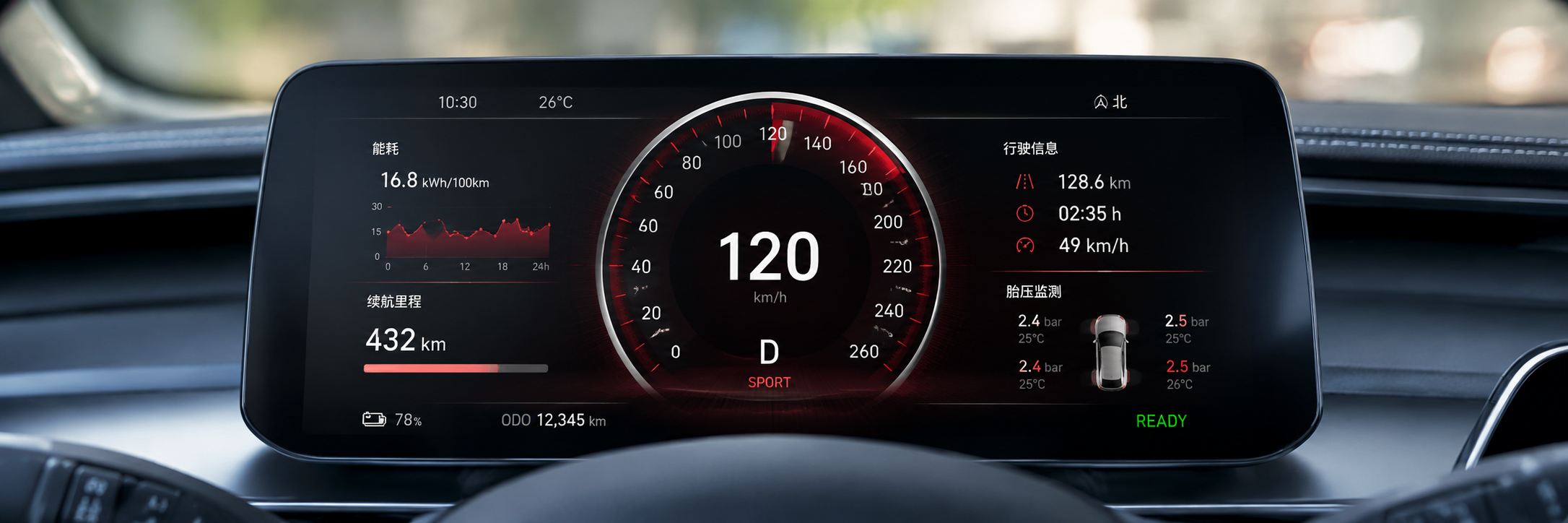
To the untrained eye, a liquid crystal display is a simple window of glass and light. But place that same piece of glass into the dashboard of a vehicle traveling at 70 miles per hour, and it suddenly becomes a frontline soldier in a brutal war against physics.
While consumer tablets enjoy a coddled life on climate-controlled office desks, an automotive display must maintain flawless performance while being baked, frozen, shaken, and blasted with blinding light. It is a world where visual elegance means nothing without raw engineering resilience.
To separate marketing hype from actual roadworthiness, B2B buyers must look past the glossy glass and decode the five uncompromising technical pillars that dictate whether an automotive LCD will thrive or die in the field.
1. The Battle Against Blinding Light: Display Brightness
There is no ambient light quite as unforgiving as direct, mid-day solar glare. When intense sunlight hits a standard screen, it washes out the contrast, rendering navigation maps practically invisible—a minor annoyance on a phone, but a dangerous distraction for a driver.
Surviving this optical assault requires a dual-pronged engineering approach. Premium automotive displays do not just rely on brute-force, high-brightness backlight modules to overpower the sun; they couple this power with sophisticated low-reflectance surface treatments (such as anti-glare and anti-reflective coatings). The goal is to ensure high-contrast readability around the clock, without turning the dashboard into a mirror.
2. Seconds Matter: Touch Response
In a smartphone app, a microsecond of touch lag is a minor inconvenience. In a vehicle traveling down a highway, that same delay is a safety hazard. The driving environment tolerates zero operational latency.
Achieving instantaneous touch responsiveness requires high-performance display driver ICs (Integrated Circuits) that boast rapid refresh rates. More importantly, these chips must possess robust anti-interference capabilities. A car's cabin is swimming in electromagnetic noise from wireless chargers, alternators, and Bluetooth modules. A premium display must filter out this background "static" to ensure that every tap, swipe, and zoom is registered flawlessly at your fingertips.
3. The Geometry of Safety: Viewing Angle
Conventional, low-cost LCD screens suffer from a fundamental geometric flaw: narrow viewing angles. When viewed dead-on, the picture is perfect. But tilt the perspective by just thirty degrees—exactly what happens when a driver looks over at a center console infotainment screen—和 elements begin to shift, losing color accuracy and contrast.
To combat this, the modern automotive standard demands mature, all-viewing-angle architectures, primarily In-Plane Switching (IPS) or Vertical Alignment (VA) panels. By ensuring the liquid crystal molecules align horizontally or vertically in specialized matrices, the display guarantees that critical data remains razor-sharp and color-accurate from any seat in the cabin.
4. Defying the Thermometer: Temperature Resistance
Few environments experience thermal swings as violent as a locked car. In the depths of a Nordic winter, interior temperatures can plunge to $-40^\circ\text{C}$; during a desert summer, the dashboard can bake at $+85^\circ\text{C}$.
Standard consumer-grade liquid crystals freeze or become sluggish in extreme cold, causing slow refresh rates and ghosting images. Conversely, extreme heat can push the liquid crystals past their clearing point, resulting in localized permanent blackouts. Automotive-grade engineering solves this by strictly utilizing specialized, wide-temperature liquid crystal materials. This thermal armor ensures that whether the vehicle is starting up in Alaska or Dubai, the display fires up instantly without a single blurred pixel.
5. The Brain in the Shadow: PCB Stability
While the LCD panel grabs the headlines, the Printed Circuit Board (PCB) hidden behind the glass is the unsung hero of the entire operation. The PCB acts as the brain, routing power, processing video signals, and managing communications with the vehicle's central computer.
In the automotive world, this brain faces constant mechanical violence from road vibrations. If a manufacturer cuts corners on PCB engineering, these micro-shocks will inevitably crack fragile solder joints, causing intermittent signal drops or catastrophic total failure. True automotive-grade quality requires optimized circuit layouts, robust structural reinforcement, and rigorous component-level failure screening. It is the unsexy, invisible engineering that ultimately guarantees a product lifespan measured in decades, not months.